Product Portrait
King pin kits
suitable for: DAF, Iveco, MAN, Mercedes-Benz, Renault, SAF, Scania, Volco etc.
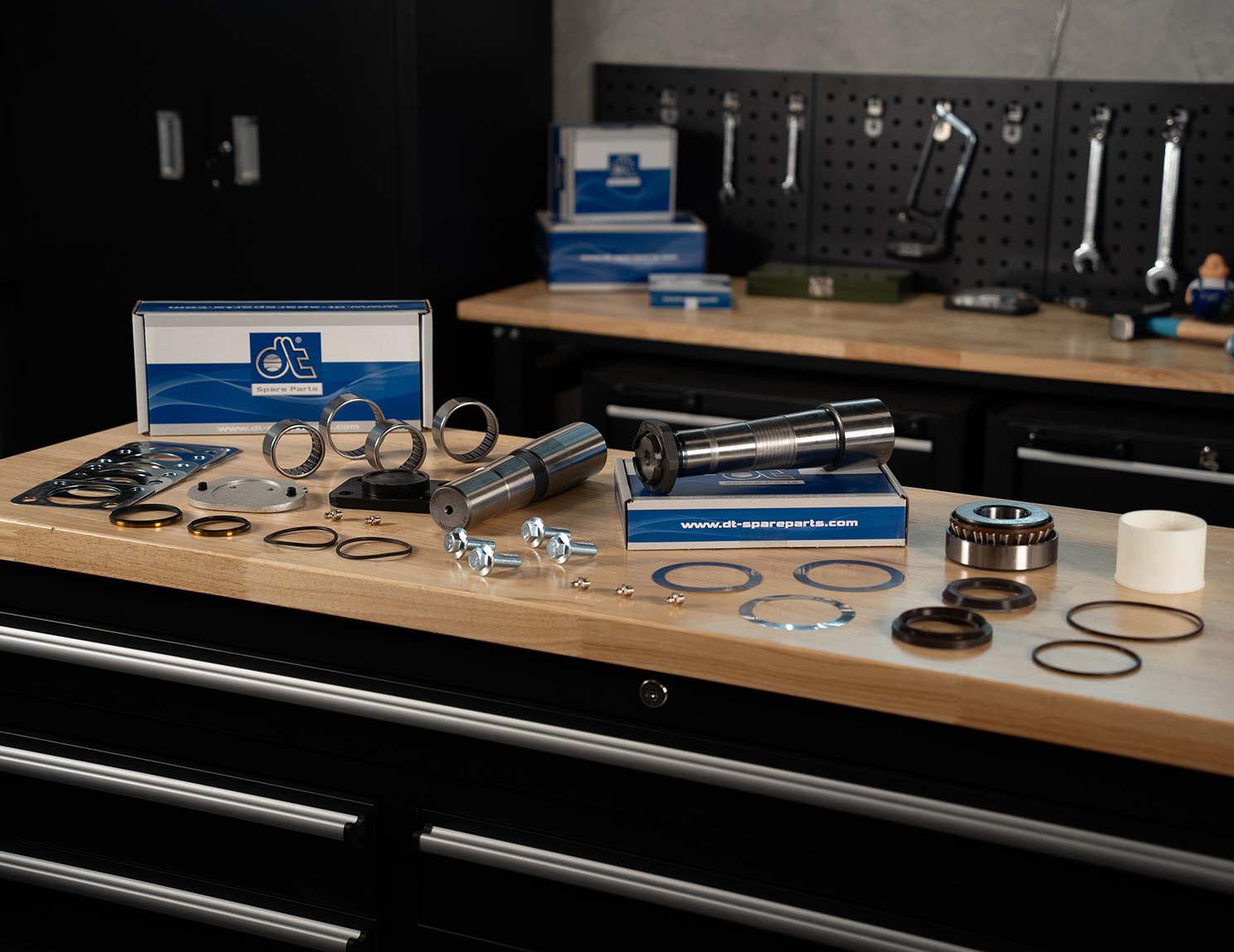
Depending on the variant, the kingpin is installed with two or more bearings and forms the central pivot point of the steering system. To ensure that it functions properly at all times, the bearing must be lubricated regularly – grease nipples are provided for this purpose. Depending on the vehicle model, kingpins are available in pressed versions without threads or with threads at the end.
All DT Spare Parts products are tested in accordance with the Diesel Technic Quality System (DTQS). Among other things, hardness, structure (roughness) and dimensional accuracy are checked. Tight tolerances are crucial here and are carefully monitored.
Defective kingpins often manifest themselves in the vehicle's handling: noises when steering, sluggish steering or noticeable tyre wear are typical signs.
‘People often think of the steering itself first, but the cause is often the kingpin,’ explains Lars. If the seals are damaged, dirt and water can penetrate the bearing. This results in corrosion and premature wear. Depending on the vehicle type, protective caps are installed, which should be checked regularly. It is also advisable to check for play: lift the vehicle, insert a rod into the rim and lift the wheel. If there is play between the steering knuckle and the axle boot, either the nut can be tightened or the steering knuckle pin must be removed. ‘It is important to always check the permissible play according to the manufacturer's specifications,’ explains the Parts Specialist.
Removing a kingpin is a labour-intensive task. First, attachments such as the push rod and tie rod must be removed. If regular lubrication no longer helps, further steps are necessary: tyres, brake calipers and other components must be removed. Lars points out that ‘the grease nipple is usually installed on a protective cap that is secured with a retaining ring.’
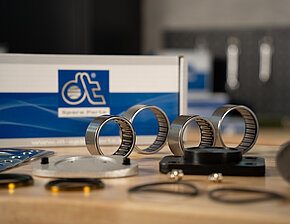
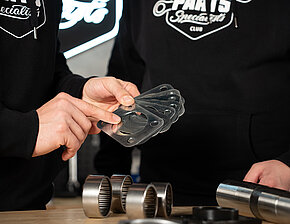
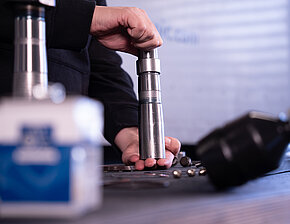
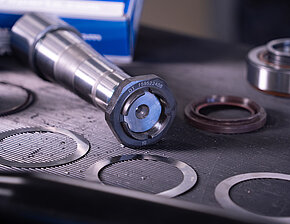
Special tools are essential for dismantling. ‘A hammer is definitely the wrong tool for this,’ warns Lars. ‘Hitting it can deform the kingpin or damage other components such as the axle, leading to changes in size.’ After removal, the steering knuckle and axle should be carefully checked for damage. The seals, pressure washers, bearings and mounting surfaces on the steering knuckle itself must be checked. New spare parts should be pre-lubricated before installation and never mounted dry. It is also essential to observe the installation direction. A tip from Lars' everyday workshop experience: ‘Put the kingpin in the freezer before installation – this causes it to contract slightly, giving you a little more leeway with the tolerances. At the same time, the axle stub can be warmed up slightly to make installation easier.’ This effect can also be used in reverse during removal.
Depending on the vehicle model, shims of varying thicknesses are used between the steering knuckle and the axle stub. It is important to ensure that the correct thickness is used and to check the play again afterwards. Another tip from Parts Specialist Lars: For vehicles with leading or trailing axles, it is advisable to check the kingpins more frequently and lubricate them regularly, not just as part of the usual maintenance intervals. These axles move less than a classic front axle and can therefore become stiff more quickly.
If you have any technical questions about Diesel Technic products and services, our Parts Specialists are happy to help via their HelpDesk and offer the right support: helpdesk.parts-specialists.com. Our Parts Specialists are now also available in the ‘PS App’. There you can send enquiries directly to our team of experts – quickly and easily with your smartphone in your pocket.